PFAS in Australian Tap Water: 2026 Results by City
Filters that reduce PFAS
-
 Amazon →
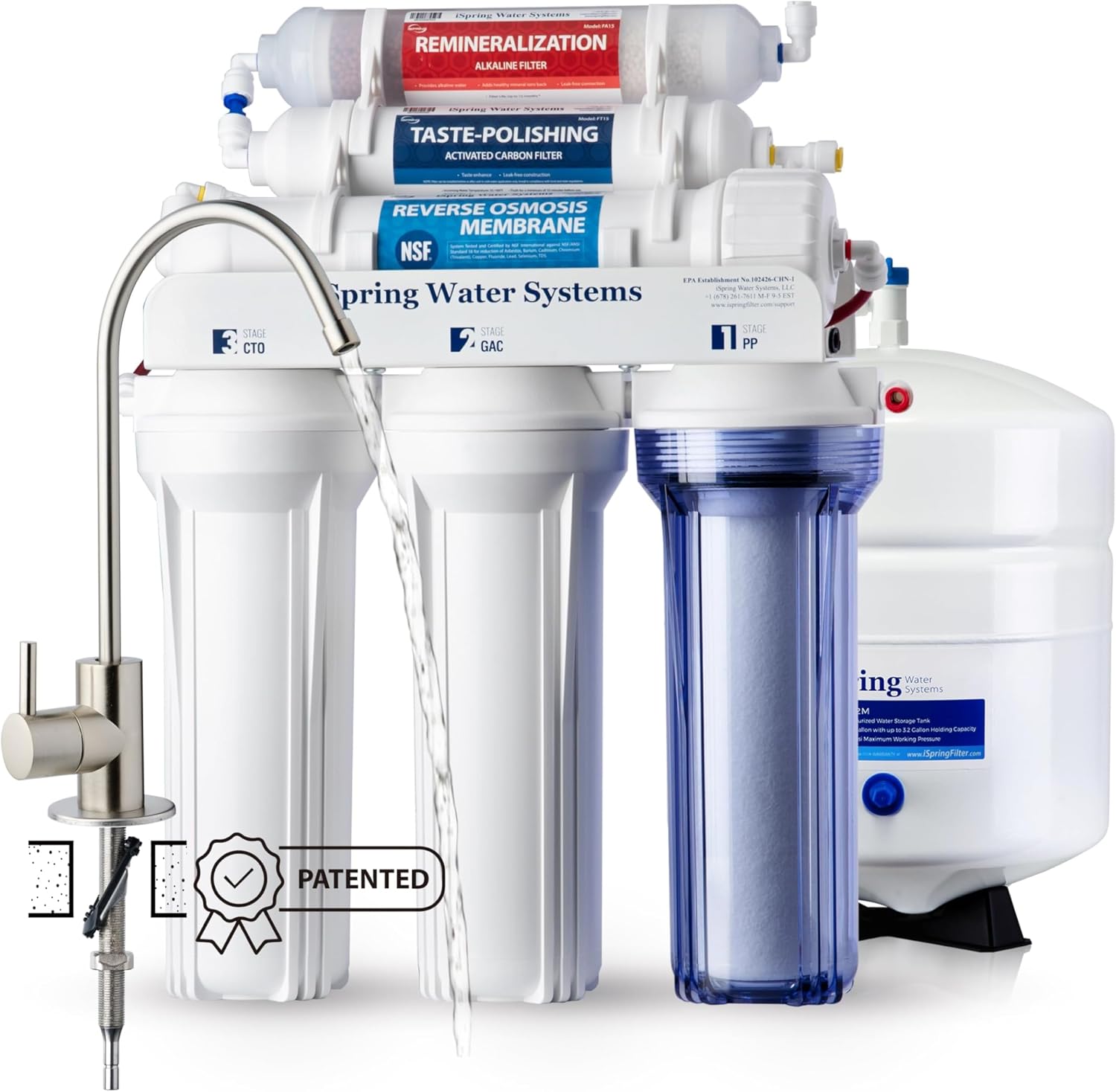
iSpring
RCC7AK 6-stage under-sink reverse osmosis system
4.6 · 13,988
-
 Amazon →
ZeroWater
2.8L 5-stage filter jug
4.2 · 5,214
-
 Amazon →
Brita
Everyday Elite 10-cup (2.4 L) filter jug
4.4 · 7,500
Sponsored links. We may earn a commission at no cost to you.
When Sydney Water first tested the upper Blue Mountains supply for PFAS in June 2024, the reservoir serving Katoomba held 16.4 nanograms per litre (ng/L) of PFOS [4]. Under the guideline of the day, that was a pass. A year later the NHMRC cut the PFOS limit to 8 ng/L, and the same result would have been double it.
So how much PFAS is in Australian tap water now? We read the latest results published by more than 50 water utilities and councils, more than 100 reports, results tables, lab certificates and government statements in all, and put the numbers side by side. In every capital city that publishes figures, the latest results sit below the 2025 limits, most of them under 2 ng/L. The supplies that have gone over since 2024 are in the Blue Mountains and a handful of regional towns, and most fixed it by shutting a bore, isolating a reservoir or adding treatment. The larger gap is in what isn’t published at all.
How We Checked the Results
PFAS are a family of thousands of synthetic chemicals, used for decades in firefighting foam, non-stick coatings and stain repellents. Australia sets drinking water values for four of them in the Australian Drinking Water Guidelines (ADWG), which the NHMRC updated on 25 June 2025 [1][2]:
| PFAS | 2025 guideline | Previous guideline (2018) |
|---|---|---|
| PFOS | 8 ng/L | 70 ng/L, PFOS and PFHxS combined |
| PFHxS | 30 ng/L | (combined with PFOS) |
| PFOA | 200 ng/L | 560 ng/L |
| PFBS | 1,000 ng/L | none |
One ng/L is one part per trillion. Utilities often report in micrograms per litre, so the PFOS limit appears in their tables as 0.008 µg/L.
To compare PFAS in Australian tap water across utilities, we took the highest published result for treated drinking water in the latest 12 months available, measured at a treatment plant outlet, a reservoir or a customer tap. The NHMRC values apply to water delivered to consumers, not to raw water in dams or bores [1], so raw-water results are reported separately and labelled. A “<2” means nothing was detected at a 2 ng/L reporting limit. Results were checked up to 22 October 2026.
PFAS in Australian Tap Water: Results by City
| City or region | Utility | Period | Highest PFOS | Highest PFHxS | Highest PFOA | Within 2025 limits? |
|---|---|---|---|---|---|---|
| Sydney (Prospect system) | Sydney Water | Jul 2025 to Jun 2026 | 1.9 | 1.0 | 0.7 | Yes |
| Hawkesbury (North Richmond) | Sydney Water | Jul 2025 to Jun 2026 | 5.1 | 7.2 | 2.5 | Yes |
| Blue Mountains (Cascade) | Sydney Water | Jul 2025 to Jun 2026 | 2.1 | 1.8 | 0.4 | Yes |
| Newcastle and Lower Hunter | Hunter Water | 12 months to Jun 2026 | 5 | 2 | <2 | Yes |
| Central Coast | Central Coast Council | Jul 2025 to Jun 2026 | 1 | 1 | <1 | Yes |
| Melbourne | Yarra Valley, South East and Greater Western Water | 2024-25 and 2025-26 | <2 | <2 | 2* | Yes |
| Geelong | Barwon Water | 2024-25 | <2 | <2 | <2 | Yes |
| Brisbane, Ipswich and Logan (Mt Crosby) | Seqwater | Mar 2025 to Sep 2026 | <0.2 | <0.2 | 0.2 | Yes |
| Part of the Redlands (Capalaba) | Seqwater | Mar 2025 to Sep 2026 | 3.6 | 0.9 | 1.3 | Yes |
| Canberra | Icon Water | Jun 2024 to Sep 2026 | <2 | <2 | <2 | Yes |
| Adelaide | SA Water | Sep 2024 to Jan 2026, source water | <2 | <2 | <2 | Yes |
| Darwin | Power and Water | 2024-25 | <0.3** | ** | <0.5 | Yes |
| Perth | Water Corporation | 2024-25 | Not published | Not published | Not published | Utility says yes |
| Hobart and Launceston | TasWater | Since May 2024 | Not published | Not published | Not published | Utility says yes |
All values in ng/L. *One sample at Romsey; not detected on resampling. **PFOS and PFHxS reported as one combined figure.
Sydney. Sydney Water publishes PFAS results for each filtration plant, weekly for the Blue Mountains and North Richmond plants, with a reporting limit of 0.1 ng/L, the lowest of any utility we checked [4]. In the Prospect system, which supplies most of Sydney, PFOS peaked at 1.9 ng/L in 2025-26. The highest Greater Sydney result came from North Richmond, which treats water from the Hawkesbury-Nepean River: 5.1 ng/L of PFOS and 7.2 ng/L of PFHxS. Its annual averages were 1.7 and 2.7 ng/L, and the river water going into the plant peaked at 6 ng/L of PFOS.
Melbourne. Melbourne Water’s catchment testing found PFOS, PFHxS, PFOA and PFBS below 2 ng/L at every site from 2024 to 2026 [9]. The three retailers test treated water in their own networks. Yarra Valley Water detected nothing in 60 samples over two years, South East Water nothing in 38 samples covering more than 50 PFAS compounds, and Greater Western Water nothing in 184 samples apart from one PFOA reading of 2 ng/L that was not detected on resampling.
South East Queensland. Seqwater publishes monthly treated-water results for three of its plants [10]. At Mt Crosby, which supplies much of Brisbane, Ipswich and Logan, PFOS has not been detected above 0.2 ng/L since March 2025. Capalaba, which supplies part of the Redlands, peaked at 3.6 ng/L of PFOS in May 2025. For the Gold Coast, Sunshine Coast and other plants, Seqwater publishes raw-water results only, all below the samplers’ limits of about 2 to 3 ng/L.
Canberra and Adelaide. Icon Water has tested treated water from its Stromlo plant 19 times since June 2024 and has never detected PFAS [11]. SA Water tested its six metro reservoirs, River Murray offtakes and several regional borefields between September 2024 and January 2026 and found nothing above its 2 ng/L reporting limit. That isn’t the same as zero. A University of Adelaide study published in 2026 measured about 3 ng/L of total PFAS, mostly PFOS, PFOA and PFHxS, in tap water from the Adelaide CBD and four suburban homes [13].
Newcastle. Hunter Water reports PFAS from its plants and customer taps every month [5]. Its 12-month results were all below its 2 ng/L reporting limit until a 5 ng/L PFOS detection appeared in the May 2026 summary, the month after it resumed drawing on the Tomago Sandbeds, an aquifer next to the contaminated area around RAAF Base Williamtown. The report gives no cause. Hunter Water says the two bore stations inside the Williamtown management area remain isolated and won’t be used for supply.
Perth and Hobart. Water Corporation’s 2024-25 report lists 274 PFAS samples from 249 localities, each marked “guideline met”, but it gives no concentrations and assessed them against the 2018 values [11]. It says WA’s Department of Health must endorse the 2025 values before they apply in Western Australia. TasWater says it has run more than 10,000 PFAS tests since May 2024 and none exceeded “an applicable health-based guideline value”, but it publishes no results. Neither claim can be checked from public data.
Darwin. Power and Water reports PFOS and PFHxS as one combined figure against the old 70 ng/L value. Its 2024-25 report, published in April 2026, said the move to the new values was planned for 1 July 2026 [11]. Darwin, Alice Springs and Tennant Creek each read below 0.3 ng/L in their single 2024-25 samples.
Where Tap Water Has Gone Over the New PFOS Limit
| Place | Utility | When | Highest PFOS in drinking water | What changed |
|---|---|---|---|---|
| Katoomba and Blackheath reservoirs | Sydney Water | Jun to Nov 2024 | 16.4 ng/L | Source dams disconnected Aug 2024; treatment added Dec 2024 |
| Jamieson and Shipley reservoirs, Blue Mountains | Sydney Water | Apr 2025 | 28.7 ng/L | Both reservoirs isolated on 3 May 2025 and cleaned |
| Warialda | Gwydir Shire Council | Dec 2024 | 39 ng/L | Hospital Park bore disconnected 13 Dec 2024 |
| Tarcutta | Riverina Water | Oct 2024 | 14.9 ng/L | Contaminated bore taken out of production |
| Narrabri | Narrabri Shire Council | Jun 2025 | 9 ng/L | Two bores switched off; treatment plant funded |
| Ayr and Brandon | Burdekin Shire Council | 2024-25 | 9 ng/L | Supplies mixed; council assessed against the old limits |
The Blue Mountains case is the best documented. WaterNSW says the contamination in two small catchment dams near Medlow Bath and Blackheath is consistent with firefighting foam. PFOS was at or above 8 ng/L at the Katoomba or Blackheath reservoir on 11 of 12 sampling dates between June and November 2024 [4]. WaterNSW disconnected the dams on 7 August 2024, and Sydney Water started a $3.4 million granular activated carbon and ion-exchange system at the Cascade plant in December 2024. PFOS at the two reservoirs has stayed below 8 ng/L since, peaking at 2.1 ng/L in 2025-26, and the October 2026 samples read 0.3 to 0.4 ng/L.
Two smaller network reservoirs took longer. In April 2025 Sydney Water found 19.7 to 28.7 ng/L of PFOS in Jamieson Reservoir and 9.0 to 9.6 ng/L in Shipley Reservoir, isolated both on 3 May 2025, and recommissioned them after cleaning. Customer taps tested at the same time peaked at 2.1 ng/L. Residents can check Katoomba’s water data, and our NSW water quality issues article covers the Blue Mountains story in more depth.
The regional NSW cases surfaced through NSW Health’s testing of all 83 council water utilities, which began in 2024 [6]. In Warialda, in the state’s north, NSW Health samples of the town supply on 5 December 2024 found 36 to 39 ng/L of PFOS and 76 to 79 ng/L of PFHxS [7]. That combined 110 to 120 ng/L was above even the old guideline, and Gwydir Shire Council disconnected its Hospital Park bore eight days later. Tarcutta, south-east of Wagga Wagga, had 14.9 ng/L of PFOS in treated water in October 2024. Riverina Water took the bore out of production, and its treatment plant outlet tested clear four times in the second half of 2025. Narrabri’s Namoi Street reservoir read 9 ng/L on 30 June 2025, five days after the new limits were published. The council switched off two bores, the reservoir’s September 2026 result was 2 ng/L, and the NSW Government has funded a $4 million treatment plant. NSW now says every council utility’s most recent treated-water result complies, though “ongoing work and longer-term investment is required to maintain current levels in some supplies” [6].
In Queensland, Burdekin Shire Council’s 2024-25 report shows treated water in Ayr and Brandon reached 9 ng/L of PFOS, with a median of 1 ng/L across 30 samples [10]. The council compared the results with the old combined limit and reported no exceedances. Its supplementary Chambers bores carry raw-water PFOS of up to 40 ng/L, and the council relies on mixing supplies to keep the network compliant. Queensland made the 2025 values enforceable as soon as they were published, and providers must notify the regulator of any exceedance immediately [10].
In the Northern Territory, Batchelor’s combined PFOS and PFHxS rose to a 30 ng/L maximum and a 20 ng/L average in 2024-25, up from a 9 ng/L maximum the year before [11]. Because Power and Water doesn’t split the figure, it isn’t possible to tell whether PFOS alone passed 8 ng/L. Power and Water is drilling for a new PFAS-free bore. Katherine, where PFAS from RAAF Base Tindal reached the town’s groundwater, read up to 40 ng/L combined in 2023-24, the year its treatment plant came online, and below 0.3 ng/L in all 25 samples in 2024-25. Katherine’s water data covers the town’s other parameters.
Every result in the table except Warialda’s met the old guideline of 70 ng/L for PFOS and PFHxS combined, which applied until June 2025. The NHMRC says there is “no immediate health risk” from water at the old values, and that a result above the new ones “should trigger an investigation” rather than be read as a pass or fail [2][3].
What the Published PFAS Results Don’t Show
“Not detected” depends on the lab. Sydney Water reports PFOS down to 0.1 ng/L and Seqwater to 0.2 ng/L. Melbourne’s retailers, Icon Water, SA Water and Hunter Water report to 2 ng/L, a quarter of the PFOS limit, so lower levels show up as “not detected”. The University of Adelaide’s 3 ng/L finding in Adelaide tap water is an example of what can sit underneath.
Only four PFAS have Australian limits. Sydney Water also tests for 41 compounds each month. The most abundant is PFBA, which has no Australian guideline value: up to 169 ng/L in a single June 2026 sample at the Cascade plant outlet, and 146 ng/L at North Richmond in January 2026 [4]. A UNSW study of 32 Sydney tap samples taken in early 2024 found 31 of the 50 PFAS it tested for, 21 of them never before reported in Australian tap water [12].
Many utilities publish no numbers. Beyond Perth and Tasmania:
- We found no published treated-water PFAS results for the Gold Coast or Sunshine Coast. Seqwater covers three plants, and the retailers that run the pipes, including Urban Utilities, Unitywater, the City of Gold Coast and Logan Water, publish no PFAS results of their own.
- Cairns Regional Council’s 2024-25 report lists its planned PFAS risk assessment, due by February 2026, as “Not started” [10]. Townsville’s report has no PFAS results for the city’s main scheme.
- NSW Health has not published supply-by-supply results from its testing of the 83 council utilities.
- Power and Water reports PFOS and PFHxS together, against the old limit.
No national body collects utilities’ results for PFAS in drinking water. The last national survey of PFAS in Australian tap water we could find was carried out in 2010, when researchers sampled 62 taps at 34 locations and found up to 16 ng/L of PFOS [14]. WaterScore’s own suburb pages currently show PFAS readings only for 16 NSW supply systems, so for other states the utility links in our sources are the best place to look.
That may change. In September 2025 the NSW Legislative Council’s PFAS inquiry recommended that utilities test source, treated and network water on a risk basis and publish the results in an accessible format. The NSW Government supported both recommendations in December 2025 [8].
How Australia’s PFAS Drinking Water Limits Compare
| Jurisdiction | PFOS | PFOA | Other limits | Status |
|---|---|---|---|---|
| Australia (NHMRC, 2025) | 8 ng/L | 200 ng/L | PFHxS 30, PFBS 1,000 ng/L | National guideline; each state decides how to apply it |
| United States (EPA, 2024) | 4 ng/L | 4 ng/L | PFHxS, PFNA and GenX 10 ng/L each | Compliance due 2029; changes proposed May 2026 |
| European Union | in sum | in sum | 100 ng/L for the sum of 20 PFAS | Applies from 12 January 2026 |
| Canada (2024) | in sum | in sum | 30 ng/L for the sum of 25 PFAS | Non-binding objective |
Australia’s PFOS limit is twice the US limit, and its PFOA limit is 50 times higher [15][16][17]. The difference is mostly one of method. The US EPA treats PFOA and PFOS as likely carcinogens with a health goal of zero, and set its limits near what laboratories can reliably measure. The NHMRC derived its values from the doses that affected laboratory animals, with safety margins, and assumed drinking water supplies 10% of a person’s PFAS intake, where the US EPA assumes 20% [3]. The PFOS value moved from a draft of 4 ng/L to a final 8 ng/L after the NHMRC’s advisory committee chose a different statistical model following public consultation [2].
The NSW parliamentary inquiry found that the ADWG still allows more PFAS than comparable international standards [8]. In the US, the EPA proposed in May 2026 to extend the deadline for its PFOA and PFOS limits to 2031 and to drop the limits for the other three compounds, and a court challenge to the 2024 rule had not been decided by October 2026 [15]. For how the NHMRC sets guideline values in general, see our guide to understanding the ADWG.
Does Boiling or Filtering Remove PFAS?
Boiling doesn’t help. The NHMRC says “PFAS are not removed or destroyed by boiling the water” [3], and because boiling drives off some water, it can slightly raise the concentration of what is left. Our article on whether boiling removes chlorine, fluoride and other contaminants explains why. Showering isn’t a concern either: the NHMRC says exposure from showering and bathing is negligible [1].
Filters vary a lot. In a 2020 study by Duke University and North Carolina State University, reverse osmosis and two-stage under-sink filters removed 94% or more of PFAS [18]. Activated carbon jugs, tap-mounted and fridge filters removed 73% on average, with wide variation between products, and four of the eight whole-house systems tested showed increased PFAS levels after filtration.
If you buy a jug or other carbon filter for PFAS, check it is certified to NSF/ANSI 53 for PFOA and PFOS reduction by NSF, IAPMO or the Water Quality Association. That test challenges a filter with water containing 1,500 ng/L of PFOA and PFOS combined, hundreds of times the levels in Australian city supplies. A reverse osmosis unit’s certification may cover only dissolved solids, but the technology itself removed 94% or more of PFAS in the Duke study. At the levels most Australian cities report, you don’t need a filter to stay within the guidelines. One may suit you if your town has had detections or if you simply want to cut your exposure further. Private bore water near a defence base or airport should be tested before you drink it, filter or not.
What You Can Do
- Check your utility’s PFAS results. Start from your utility’s page on WaterScore, such as Sydney Water, Seqwater, Icon Water or SA Water, then follow the utility links in the sources below. Our guide to reading a water utility report explains the tables.
- Ask your council if it publishes nothing. Request its latest PFOS, PFHxS, PFOA and PFBS results and the reporting limit used. In Queensland, providers must tell the regulator immediately if a result exceeds the new values.
- Test private bore water before drinking it if you live near a defence base, airport or firefighting training ground. Use a NATA-accredited laboratory.
- Choose reverse osmosis if you want PFAS gone. An under-sink unit removes nearly all of it. Our reverse osmosis vs carbon filters guide compares the options, and the best water filter for Katoomba page matches products to Blue Mountains water.
- Learn the background. Our explainer on what PFAS are and how they get into water covers the chemistry, the defence-base contamination sites and the health evidence.
Frequently Asked Questions
Is there PFAS in Australian tap water?
Yes, at trace levels in many supplies. In every capital city that publishes results, the latest tests are below the June 2025 guidelines, mostly under 2 ng/L against a PFOS limit of 8 ng/L. Since 2024, drinking water above the new PFOS limit has been recorded in the Blue Mountains and the regional towns of Warialda, Tarcutta, Narrabri and Ayr, which have since shut bores, blended supplies or added treatment.
Which Australian town has had the highest PFAS in its tap water?
Of the results published since 2024, Warialda in northern NSW is the highest. NSW Health samples of the town supply taken on 5 December 2024 found 36 to 39 ng/L of PFOS and 76 to 79 ng/L of PFHxS, above even the old guideline. Gwydir Shire Council disconnected its Hospital Park bore on 13 December 2024.
Is Sydney tap water safe from PFAS?
Sydney Water’s 2025-26 results are all below the guidelines. PFOS peaked at 1.9 ng/L in the Prospect system that supplies most of Sydney, 2.1 ng/L in the Blue Mountains after treatment was added, and 5.1 ng/L at North Richmond, against a limit of 8 ng/L. Sydney Water tests down to 0.1 ng/L and publishes its results online. Our Sydney tap water guide covers its other parameters.
Does boiling water remove PFAS?
No. The NHMRC says PFAS are not removed or destroyed by boiling. Boiling drives off some water, so it can slightly raise the concentration of what is left. Reverse osmosis is the most reliable way to remove PFAS at home.
What water filter removes PFAS?
Reverse osmosis and two-stage under-sink filters removed 94% or more of PFAS in a 2020 Duke University study of household filters. Activated carbon filters such as jugs removed 73% on average, with wide variation between products. Look for certification to NSF/ANSI 53 or 58 for PFOA and PFOS reduction.
Can you flush PFAS out of your body?
Only slowly. A Swedish study of people who had drunk contaminated water estimated half-lives of 3.4 years for PFOS, 5.3 years for PFHxS and 2.7 years for PFOA [19]. In a trial of 285 Fire Rescue Victoria firefighters, donating plasma every six weeks for a year lowered blood PFOS by 2.9 ng/mL on average, and donating blood every 12 weeks lowered it by 1.1 ng/mL [20].
Summary
PFAS in Australian tap water sits at trace levels in most cities, and every capital that publishes results is below the June 2025 limits. The supplies that went over the new PFOS limit since 2024 were mostly on bore water, and most fixed it by shutting bores or adding treatment. What still needs fixing is disclosure: Perth, Tasmania and much of regional Queensland publish no PFAS numbers at all.
Sources
- National Health and Medical Research Council, Per- and poly-fluoroalkyl substances (PFAS) fact sheet, Australian Drinking Water Guidelines version 4.0, June 2025
- NHMRC, Review of PFAS in Australian drinking water and Updated Australian Drinking Water Guidelines, 25 June 2025
- NHMRC, PFAS review: questions and answers
- Sydney Water, PFAS monitoring results and Update on PFAS treatment at Cascade Water Filtration Plant, October 2026
- Hunter Water, PFAS; Central Coast Council, PFAS monitoring
- NSW Government, PFAS and drinking water: information and updates and ministerial release, 25 June 2025
- Envirolab for NSW Health, Certificate of analysis 368356 (Gwydir), December 2024; Narrabri Shire Council, PFAS testing; Riverina Water, PFAS test results
- NSW Legislative Council Select Committee on PFAS, Report 1, 11 September 2025
- Melbourne Water, Monitoring for PFAS in our water supply catchments; Yarra Valley Water, Drinking Water Quality Report 2025-26; South East Water, Drinking Water Quality Annual Report 2024-25; Greater Western Water, PFAS test results; Barwon Water, 2024-25 Annual Drinking Water Quality Report
- Seqwater, PFAS and drinking water; Burdekin Shire Council, Annual DWQMP Report 2024-2025; Cairns Regional Council, Drinking Water Service Annual Report 2024-25; Queensland Government, PFAS regulation for drinking water service providers
- Icon Water, PFAS and drinking water; SA Water, PFAS and drinking water; Water Corporation, Drinking Water Quality Annual Report 2024-25; TasWater, What is PFAS; Power and Water, 2025 Drinking Water Quality Report
- Hua and Donald, “Assessment of per- and polyfluoroalkyl substances in Sydney drinking water”, Chemosphere 385 (2025); UNSW, More types of PFAS in Sydney tap water than previously thought, August 2025
- Winstanley et al., Environmental Research 296 (2026); University of Adelaide, Chemicals found in tap water could harm embryos, April 2026
- Thompson, Eaglesham and Mueller, “Concentrations of PFOS, PFOA and other perfluorinated alkyl acids in Australian drinking water”, Chemosphere 83 (2011)
- US Environmental Protection Agency, Per- and polyfluoroalkyl substances (PFAS) drinking water regulation
- European Commission, New EU rules limit PFAS in drinking water, 12 January 2026
- Health Canada, Objective for Canadian drinking water quality: per- and polyfluoroalkyl substances, August 2024
- Herkert et al., “Assessing the effectiveness of point-of-use residential drinking water filters for perfluoroalkyl substances”, Environmental Science & Technology Letters 7 (2020)
- Li et al., “Half-lives of PFOS, PFHxS and PFOA after end of exposure to contaminated drinking water”, Occupational and Environmental Medicine 75 (2018)
- Gasiorowski et al., “Effect of plasma and blood donations on levels of PFAS in firefighters in Australia”, JAMA Network Open 5 (2022)
Filters that reduce PFAS
Reverse osmosis, plus two jugs certified to NSF/ANSI 53 for PFOA and PFOS. Amazon Australia ratings as at October 2026.
iSpring
RCC7AK 6-stage under-sink reverse osmosis system
4.6 · 13,988 ratings on Amazon
Reverse osmosis removed 94% or more of PFAS in independent tests. This unit's NSF/ANSI 58 certification covers dissolved solids rather than a PFAS claim, and it needs a plumber or a confident DIYer to fit.
ZeroWater
2.8L 5-stage filter jug
4.2 · 5,214 ratings on Amazon
Certified by IAPMO to NSF/ANSI 53 for PFOA and PFOS: in testing it cut 1,500 ng/L to no more than 4 ng/L. The catch is filter life of about 57 litres, so refills add up. Ships from Amazon US.
Brita
Everyday Elite 10-cup (2.4 L) filter jug
4.4 · 7,500 ratings on Amazon
Its Elite filter is certified by IAPMO to NSF/ANSI 53 for PFOA and PFOS, cutting them by 98% in testing, and lasts about 454 litres or six months. A US model that ships from Amazon US.
Disclaimer: This article is for general informational purposes only and does not constitute medical advice, health recommendations, or professional guidance of any kind. The health and safety information discussed should not be used as a substitute for consultation with qualified health professionals. Data referenced may not reflect current water conditions. For specific concerns about your drinking water, consult your local water utility, a licensed water testing laboratory, or a health professional. See our Terms of Use.
Cite
Cite this page
Free to quote and reuse with a credit to WaterScore and a link to this page. Journalists and researchers can find key figures and contacts on our press and data page.
WaterScore. (2026, October 22). PFAS in Australian Tap Water: 2026 Results by City. https://waterscore.com.au/articles/pfas-in-australian-tap-water/
Written by

Environmental Health Writer
Science journalist covering water infrastructure and environmental health across Australia.
Reviewed by

Lead Water Quality Analyst
Environmental scientist and water quality researcher with a PhD from the University of Melbourne.
What You Can Do
Check the water quality in your area and find the right filter for your needs.
Sponsored Amazon link. Check Amazon for current price and availability.
Related Articles
Water Quality Issues in NSW: What the Data Shows
Water quality issues in NSW span PFAS in Blue Mountains tap water to high-sodium bore water out west. We break down the real data, the risks, and what to do.
Can Babies Drink Tap Water in Australia?
Can babies drink tap water in Australia? We check nitrate and fluoride levels across every state using real utility data, and explain what's safe by age.
Can You Drink Tap Water in Australia? (2026 City Data)
Can you drink tap water in Australia? Yes, in every capital city. See measured hardness, chlorine and fluoride by city, plus where remote towns differ.